
VELUX launches new approach to unlock the full potential of existing building stock
Findings and data from a new green paper initiated by the VELUX Group show how better use of existing buildings can help address Europe’s housing, climate, energy and health crises. To unlock this potential, VELUX launches its Re:Living approach - a holistic renovation framework focused on health, affordability and sustainability.
Across Europe, demand for housing is rising while the current building stock remains underused, outdated or inefficient. The EU is projected to need more than two million additional homes per year, while buildings account for 40% of final energy use and 36% of energy-related greenhouse gas emissions. At the same time, one in three Europeans is exposed to unhealthy indoor climate conditions at home.
Fortunately, Europe has an enormous housing opportunity hiding in plain sight: unlocking the potential of the buildings already standing.
As the UIA World Congress of Architects 2026 in Barcelona comes to an end, the VELUX Group releases the new green paper: “The Housing We Need For The Future We Want”. The paper and research behind it is initiated by VELUX and developed in collaboration with ARTELIA, BPIE, RISE and No Objectives, and sets out how Europe can address four interconnected crises - unaffordable housing, unhealthy homes, energy and resource insecurity, and climate and biodiversity breakdown - by placing the existing building stock at the centre of the solution.
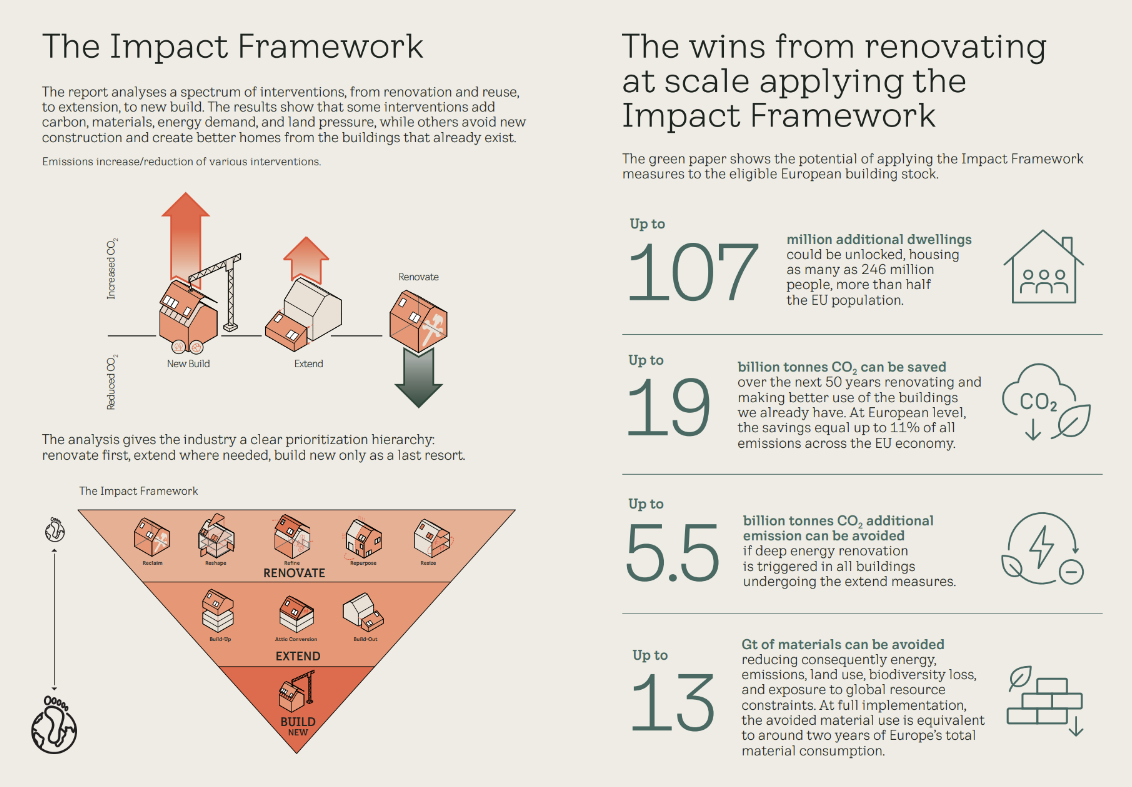
The paper shows that new construction alone cannot solve these challenges. Most of the buildings Europe will rely on in 2050 are already standing, with around 85% of today’s building stock expected to remain in use. Therefore, the opportunity is to access untapped housing by renovating, adapting, reusing and better utilising what already exists. Europe can unlock between 50 and 107 million additional homes – this equals housing for an estimated 115 to 246 million people, while reducing pressure on land, materials and energy systems.
The potential climate impact is equally significant. Better use of Europe’s existing building stock could avoid between 3.9 and 19 billion tonnes of CO₂eq over the next 50 years. At the upper end, the annual savings are comparable to the emissions of every car on Europe’s roads combined.
From insights to action: Introducing Re:Living
To pioneer how this agenda can be turned into practice, the VELUX Group is launching Re:Living – a new approach extending its award-winning Living Places concept into renovation. With Re:Living, VELUX suggests a holistic renovation approach focused on health, affordability and sustainability. The approach explores how renovation can become more structured, scalable and accessible by working through four steps: Re:Think, Re:Scope, Re:Design and Re:Cover. Together, these steps aim to make renovation a more attractive and achievable choice for homeowners, professionals and pro-partners.
Europe has in fact an abundance of the housing infrastructure it needs. The question is how we unlock it. With Re:Living, we want to show how renovation can move from isolated projects to a scalable response to some of Europe’s most urgent challenges.

Read more about Re:Living here.
About the Green Paper: The housing we need for the future we want
The green paper identifies a range of measures, including refining existing homes through energy and comfort upgrades, reclaiming vacant housing, repurposing underused non-residential buildings, reshaping oversized homes, resizing how space is used, extending existing structures through attic conversions, building up or building out, and low carbon new build where new construction is needed.
The green paper builds on a large-scale research study by BPIE and partners for the European Commission, which developed 10,000 building archetypes representing the EU building stock. These archetypes provide one of the most comprehensive and detailed models of Europe’s buildings available today, including life cycle assessments of existing buildings, renovation scenarios and new construction. In this study, the same model was used to assess the potential impact of the proposed nine measures and estimate how widely they could be applied across Europe’s 21 billion m² residential building stock.
The green paper is published as an invitation to policymakers, building industry, researchers and civil society to discuss how Europe can scale up renovation and make better use of the buildings it already has.
Read the full green paper here.
About the VELUX Group
VELUX roof windows have been bringing daylight and fresh air into peoples’ homes around the world for more than 80 years, creating better living environments. We offer a range of products including roof windows and modular skylights, decorative blinds, sun screening products, and roller shutters, as well as installation and smart home solutions. They help create bright, healthy, and energy-efficient places for people who live, work, learn, and play under the roof. We work globally – with sales and manufacturing operations in 37 countries and around 11,400 employees worldwide. The VELUX Group is owned by VKR Holding A/S, a limited company owned by the Villum Foundation and members of the Kann Rasmussen family. In 2025, the VELUX Group had a total revenue of EUR 2.97 billion while VKR Holding had a total revenue of EUR 4.11 billion. The same year, the Villum Foundation and the VELUX FOUNDATION donated a total of EUR 306 million in charitable grants.
For more information about the VELUX Group, visit velux.com.